
Digital Governance and Governmentalities: Feminist Perspectives
By: claire crawford (SHE/HER)
In Hindutva India, activists must navigate digital practices of control such as internet shutdowns, social media shadowbans and threats of doxxing. Thinking about digital governance from the perspective of feminist resistance reveals a co-constitutive structure of state and corporate power.
“A feminist analysis of power sees the state, technology companies, and pro-government activists as part of a co-constitutive matrix of diffuse digital governance”
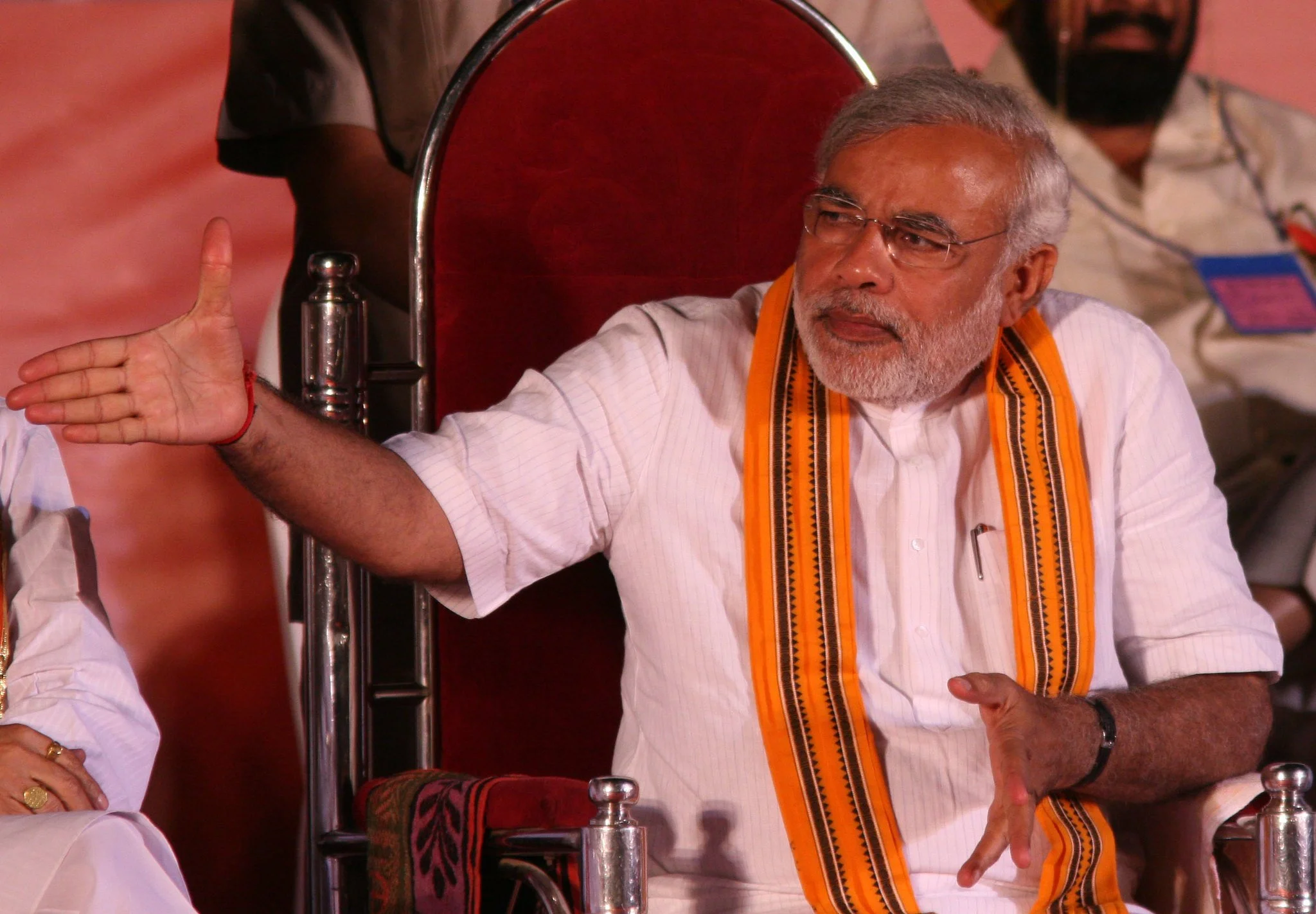
Narendra Modi at a BJP rally, by Al Jazeera English is licensed under CC BY-SA 2.0.
Literature on digital technologies and resistance often falls into a binary of techno-optimism or pessimism, seeing tools of empowerment or instruments of control. This article argues that considering digital developments from the perspective of feminists, we can read these as interconnected, rather than oppositional. This is possible through a feminist analysis of power that sees the state, technology companies, and pro-government activists working together to shape digital governance and control.
The article draws on the experiences of feminist activists in northern India to demonstrate how seemingly disconnected digital practices together form a threatening digital landscape to be navigated with caution. Although they came from different parts of a loosely defined feminist ‘movement’ – some were employed in feminist organisations, others organised within informal collectives, some ran social media accounts sharing feminist memes – all of the activists interviewed reported shared concerns about their freedom and safety online.
Their shared context is Hindutva India: the India of the BJP government (since 2014), Prime Minister Modi, and Hindu majoritarian society. Hindutva ideology is associated with anti-feminist, anti-Muslim and upper-caste hegemonic politics. Online, activists demonstrate a kind of digital governmentality: self-regulating in response to fear, uncertainty, suspicion, stress, shame, and discomfort. The article considers three practices in particular, to represent the tools available to the state, platform corporations, and pro-government (Hindutva) activists: shutdowns, shadowbanning and doxxing.
Shutdown, shadowbanned, doxxed
Internet shutdowns are the most blatant expression of state control over the digital landscape. The shutdown in Indian Occupied Kashmir following the revocation of Article 370 (which removed the region’s constitutional autonomy) had implications transnationally, limiting not just communication, but representational mechanisms and solidarities. The feminist concern for representation through a focus on authenticity and amplification was effectively disrupted. The rapid increase in the use of shutdowns is unevenly weaponised across the country and can be understood as a form of coloniality in postcolonial governance.
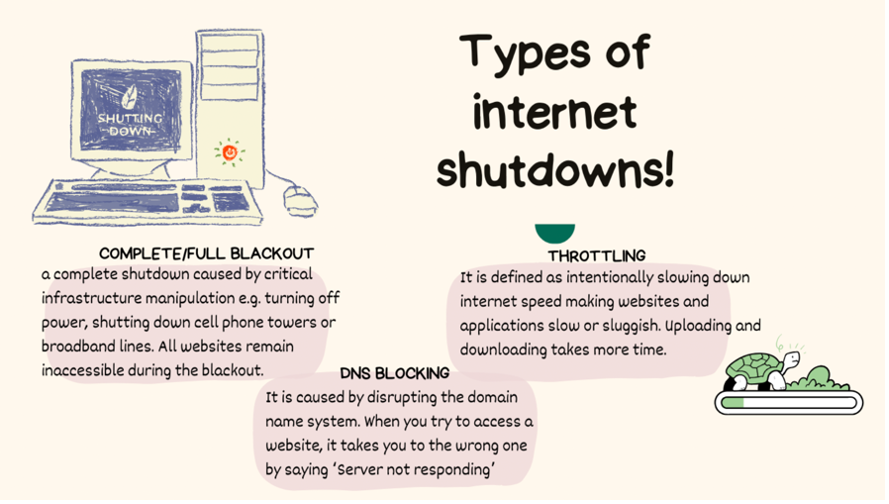
Infographic explaining types of internet shutdowns. With permission: sajadrasool.com/digitalsafety
Shadowbanning is less obviously a tool of governance. Activists had a wide range of theories about how platforms prioritise or suppress their content, but were consistent in their analysis of these decisions as political, with frequent reference to the close relationship between social media companies and the government. The lack of transparency by platforms themselves becomes an effective tool of control, as the uncertainty leads to self-censorship in order to circumvent perceived restrictions. Shadowbanning and algorithmic downgrading remain unclear to researchers and activists alike, as companies have often only confirmed details about their moderation practices following incidents of whistleblowing.
Doxxing, a breach of privacy by sharing identifying details about somebody online without their consent, provides a starting point to understand how activists perceive digital spaces as containing direct and individual threats. The vast network of ‘bhakts’ (a pejorative colloquialism for Hindu majoritarian ‘devotees’) working with the ruling Bharatiya Janata Party’s ‘IT Cell’ (a well-calibrated digital campaign apparatus) has been responsible for numerous incidents of doxxing of activists, in a practice that is disproportionately targeted against women, Muslims and Dalit, Adivasi & Bahujan people. The threat of being doxxed is particularly effective in evoking digital governmentality: deterring activists from organising in digital spaces.
Together, these practices of shutdowns, shadowbanning and doxxing illustrate a challenging landscape for feminist politics. From the perspective of feminist activists, government suppression, platform moderation and online harassment work together to create a dangerous and threatening digital landscape. Despite obstructions, feminist activists are clearly not passive, and digital governmentality does not invoke quiet acquiescence. They are working to understand, navigate, endure and resist these digital conditions in which they are organising. The article highlights multiple strategies, including using linguistic codes, anonymity, and working between the online and offline. These strategies shift constantly in response to the threat and perceived threat of surveillance.
The future implications of the research are twofold. Firstly, as researchers, a focus on bottom-up and resistance perspectives can lead to different understandings of emerging technologies. This will surely remain the case as people learn to live with the outputs and outcomes of Generative Artificial Intelligence. Secondly, regulation alone is not a route to meaningful democratic protection, as state-corporate interests often align and collude to exert digital control. Together, these implications alert us towards the fact that even though the politics of digital governance is predominantly shaped by regulation, it is also ruptured by the feminist everyday and adaptive resistances against these technologies of control.
Read the full article here: Shutdown, shadowbanned, doxxed: Hindutva governance and digital governmentalities
Each blog post gives the views of the individual author(s) based on their published IFJP article. All posts published on ifjpglobal.org remain the intellectual property and copyright of the author or authors.

Claire Crawford (she/her) is based in the Department of Politics and International Studies, University of Cambridge. She completed her PhD at King’s College London and a Postdoctoral Fellowship at the University of York.