
Gendering Internal Colonialism: Engaging Reproductive Justice and Digital Testimony of Uyghurs
By: CRYSTAL WHETSTONE (she/her) AND MURAT YILMAZ (he/him)
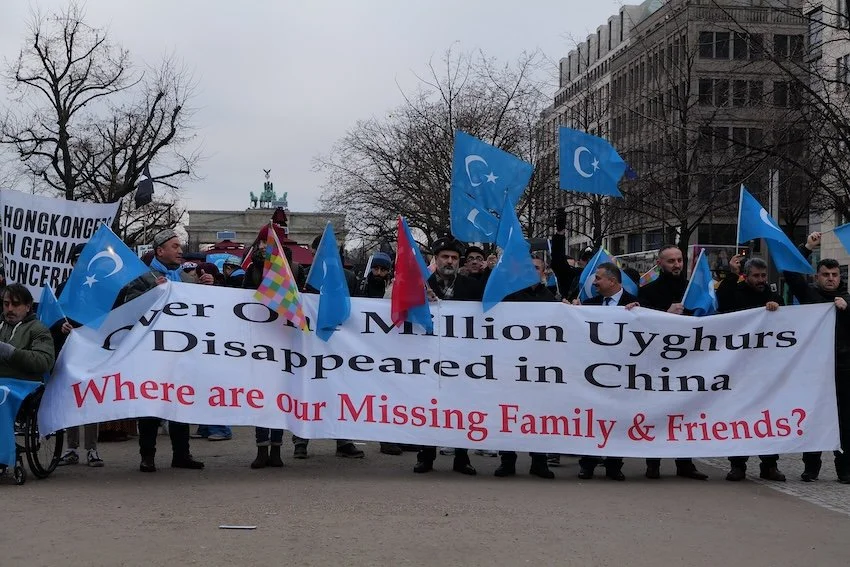
Demonstration for Uyghurs’ Rights on January 19, 2020, in Berlin, Germany. Photo credit: Leonhard Lenz (CC0 1.0 Universal Public Domain Dedication)
Reproductive justice, a term developed by US women of color, in the context of western China illuminates a gendered internal colonialism of the peripheralized Uyghur community. Uyghurs raise the question of international interventionism – and its attendant colonialism and saviorism – in reproductive justice activism.
“Separating Uyghur mothers from their children, the Chinese state seeks to raise a ‘Han’ generation of Uyghurs.” --Rukiye Turdush
Uyghurs and reproductive justice: Thinking globally
The Uyghurs are a marginalized Turkic and largely Muslim community in western China with an estimated total population of 11 million. Uyghurs have long been subjected to a ‘mass birth-prevention strategy’ by the state, propagated through forced sterilization of Uyghur women and mass internment of Uyghur men of childbearing age. The Chinese state has systematically separated a number of Uyghur children from their parents to be assimilated into Han practices in boarding schools. These strategies which include forced sterilization and separating children from their Uyghur parents constitute a crime against humanity and a war crime, as per the Rome Statute. Against this backdrop, a contextual discussion on reproductive justice for the Chinese Uyghur community ensues.
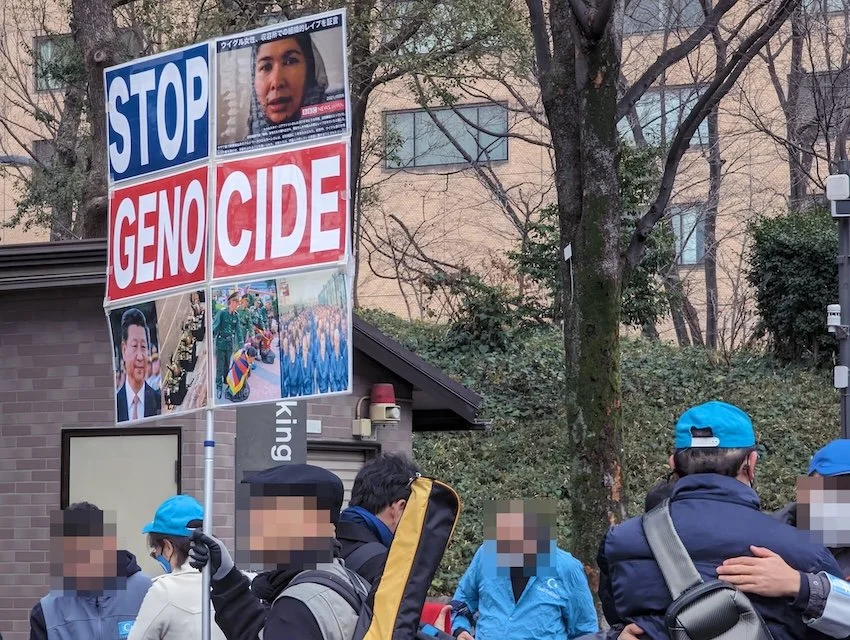
Uyghurs demonstration against genocide February 4, 2024, in Tokyo Japan. Photo credit: Syced (CC0 1.0 Universal Public Domain Dedication)
Originally, the term reproductive justice was coined by US women of color to highlight reproductive rights beyond abortion which—specifically, the ability to safely bear and raise children. This framework moves beyond rights on paper to include access to birth control, abortion, and safe environments in which to raise children. Can reproductive justice usefully be applied to Uyghurs? Can the Uyghurs offer new insights about reproductive justice? Linking this framework to the Uyghur context allows us to examine both the ways reproductive justice illuminates their experience, and how those experiences, in turn, complicate and extend the framework itself.
With evidence of forced sterilization and forced abortion among China’s Uyghurs, a reproductive justice lens suggest these practices constitute “reprocide”—genocide perpetrated through reproductive violence. We, therefore, suggest that reproductive justice has something to say about Uyghurs. At the same time, we argue that, the reproductive violences inflicted on Uyghurs enriches the existing framework of reproductive justice activism through discursive engagement.
Internal colonialism: A gendered concept
The Chinese state inflicted reproductive violence on Uyghurs is a testament of internal colonialism. Internal colonialism explores core-periphery relations inside states to highlight economic differences between dominant and peripheralized groups. In China, the majority Han are the dominant group, while the Uyghurs have been peripheralized. We argue that this colonial power relation is also gendered.
Gendering plays a role in justifying colonialism—both internal and external. However, our study is prompted by the gap in literature on internal colonialism. The existing literature pays inadequate attention towards the Uyghur condition. Gender, ethnicity, religion and language mark Uyghur women as not only a subordinated community in China but a subordinated gender in a subordinated community. Their position at the intersection of multiple forms of marginalization makes them especially vulnerable to state policies aimed at controlling reproduction.
Uyghur women, who overwhelmingly carry out the biological and social reproduction of the next generation, are targeted by the Chinese state for their reproductive capacity—marking this as a distinctly gendered strategy of internal colonialism. Imagining internal colonialism as a gendered concept allows reproductive justice to lend a crucial lens for understanding the Uyghur case. As reproductive justice theory suggests, the state exploits women’s bodies to harm and eventually, weaken the broader community. Yet, at the same time, even in the face of repression, the Uyghur women continue to resist the colonial Chinese state through the practices of mothering, specifically biological and social reproduction, which includes raising children in social practices.
What reproductive justice thinkers must consider: Resisting political repression
To understand the depth of reproductive violence against Uyghurs, it is essential to situate these practices within the broader political repression that structures their everyday lives. This repression is vividly illustrated in the digital testimonies of Uyghur women, many of whom have spoken publicly about their experiences. These testimonies, presented at the UK’s Uyghurs Tribunal in 2021—a people’s tribunal—underlines the trauma experienced by Uyghur women due to coerced birth control, sterilization, abortions, and the forced separation from their children. What emerges from these narratives is not only the saga of Uyghur women’s plight but also a recognition of the community’s collective loss. These losses include the loss of family, continuity, and hope for a meaningful communal future.
These testimonies, frequently seeking international intervention, largely stem from the Uyghur diaspora, who may not necessarily represent the authentic views of the community members residing in China. In fact, the positionality of the listeners to these testimonies also showcases a direct disconnect from the ground reality in the making of the interventionist discourse. This discourse comes from the so-called “experts” from international organizations, both intergovernmental and nongovernmental, bringing ideas and ways of doing things to typically global South spaces, often through “capacity training” or sending peacekeeping troops. As feminists stress, international interventionism is replete with colonialism that promotes binary of “civilized” and “barbarian” and furthers the Western saviour complex.
Given its roots in the US, reproductive justice activists and scholars see its application as global. Yet the extremely oppressive environment in the Uyghurs homeland means there are few possibilities to organize against the state. Equally frustrating, international intervention will likely not end colonialism for Uyghurs. Rather it would likely bring new forms of it through the employment of “outside experts” and their “capacity-building” workshops and trainings, all of which only further inequalities at the global level.
Even though the global order is under reconfiguration, the remnants of colonialism continue to have its deeply entrenched roots. To avert these colonial traces, the reproductive justice thinkers and activists across diverse sites must find creative and peaceful means of pushing for change—even under repressive climates. We don’t presume to have a solution. Rather, we emphasize the insights of a reproductive justice lens for Uyghurs and ask reproductive justice thinkers to consider the implications of an international intervention.
Read the full article here: Gendering internal colonialism: engaging reproductive justice and digital testimony of Uyghurs in diaspora
Each blog post gives the views of the individual author(s) based on their published IFJP article. All posts published on ifjpglobal.org remain the intellectual property and copyright of the author or authors.

Crystal Whetstone is an Assistant Professor at Bilkent University's Department of International Relations. Her research specializes in gender, peace, violence and security with a focus on motherhood.



Murat Yılmaz is a junior scholar of International Relations at Kastamonu University located in Kastamonu, Türkiye. He focuses on transnational authoritarianism, cyber security, immigration and gender in the context of the Uyghurs, diaspora and China's oppression of minorities.