
“May That Nuclear War Be Cursed!”: Reading Nuclear Power Through Feminist and Queer Resistance
By: Tatsiana shchurko (she/her)
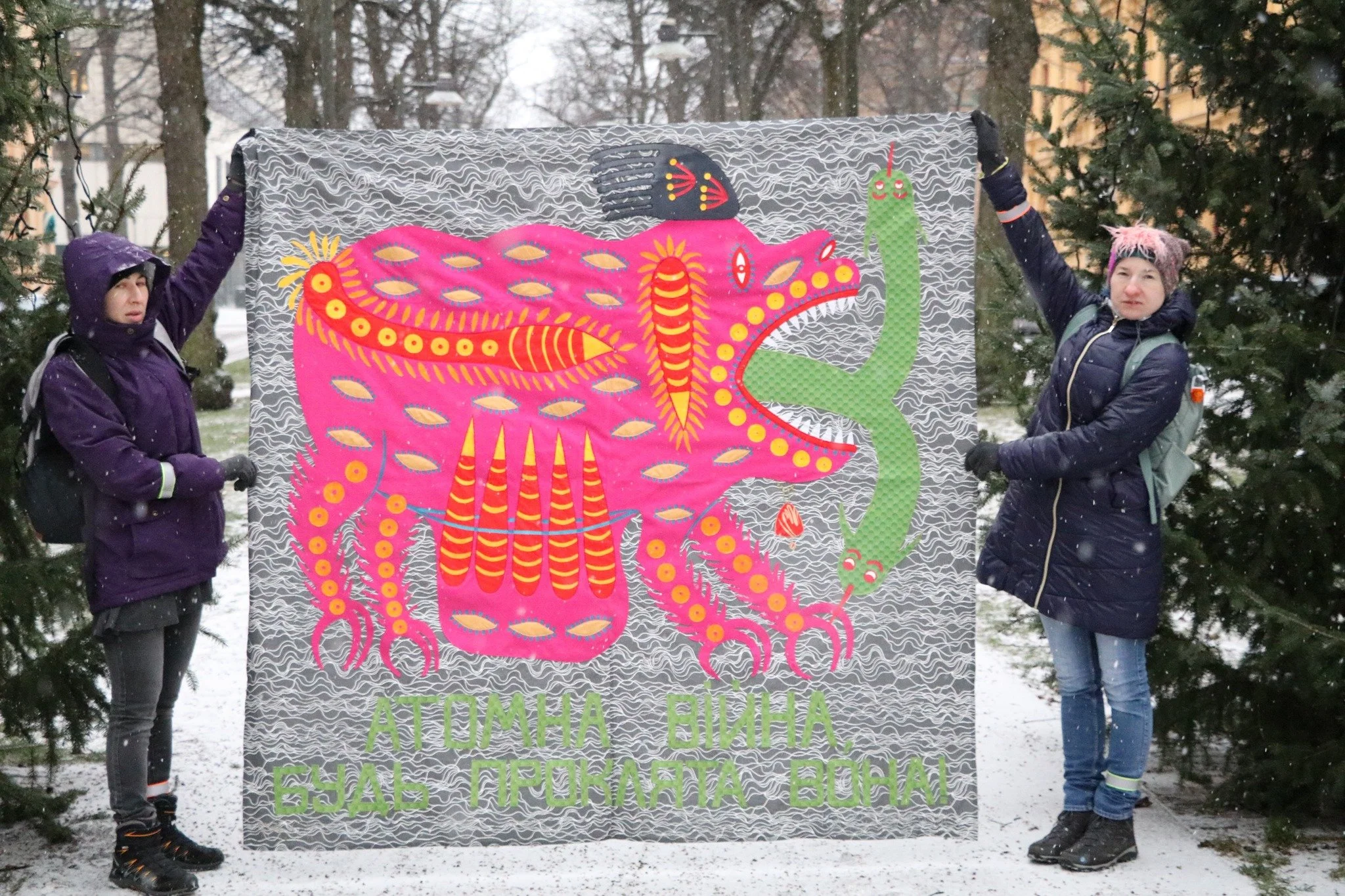
Photo 1 – Textile anti-war banner inspired by Maria Prymachenko’s “May That Nuclear War Be Cursed!” (1978). Created by artists Ton Melnyk and Masha Ravlyk of the Ukrainian feminist collective ReSew (2022). Photo courtesy: Ton Melnyk and Masha Ravlyk (rights owned by the artists).
The postsocialist and anti-imperial lens, adopted in this paper, extends the critique of Cold War binaries, emphasizing how multiple empires remain embedded in nuclear infrastructures and global hierarchies and centering the lived consequences of nuclear imperialism, particularly its impact on Indigenous and native communities.
In 1978, Ukrainian folk artist Maria Prymachenko painted a pink, spotted creature containing bombs, titling it “May That Nuclear War Be Cursed!”. The painting’s monstrous whimsy masks a fierce refusal: a cry against nuclear violence. This image offers more than symbolism: it opens a window into how people live through empire’s ruins—and how resistance can be imaginative, embodied, and translocal. Such images, packed with symbolism, often capture the political realities of time. Hence, I argue that it is imperative to turn to art as well instead of just usual political archives for a meaningful study of nuclear power.
I ask: what does it mean to study nuclear power through a postsocialist queer lens? I argue that the story of the atomic age is not merely a Cold War rivalry but a network of overlapping empires whose effects continue today—from the Pacific to Eurasia and South Asia. Seen through feminist, queer, and Indigenous perspectives, nuclear infrastructures reveal how ideas of progress, time, and the worth of lives are shaped by empire. Empire, in my research, means a network of overlapping imperial formations and refers to an interlocking system of domination that organizes land, labor, time, and life through nuclear and infrastructural violence—an ongoing formation of “Cold War coloniality” sustained by racialized, gendered, and ecological hierarchies, and contested through feminist, queer, and Indigenous refusal and imagination.
My article develops postsocialist queer reading, drawing on Lesia Pahulich’s conceptualizations of postsocialist queer critique, to show how both capitalist and socialist powers have used nuclear technologies to claim land, organize labor, and define disposability. Yet across these irradiated geographies, feminist, queer, and Indigenous communities continue to refuse imperial disposability and reimagine life, care, and solidarity beyond empire. Even though they are seemingly fragile connections, they have enduring resonances linking Chornobyl (Ukraine) and Semipalatinsk (Qazaqstan) with Kudankulam (India) and the Pacific Islands. Put together, their resistance might gesture toward a different kind of internationalism, one grounded in care, refusal, and shared survival.
“Prymachenko’s fantastical creatures and apocalyptic landscapes do more than critique nuclear domination, they disrupt linear chronologies and reveal imperial violence as recursive, layered and unresolved.”
Rethinking the Cold War
The Cold War is often remembered as a standoff between two superpowers—the United States and the Soviet Union. However, this binary hides more than it explains. My work challenges this view by showing how both empires built nuclear infrastructures on Indigenous and native lands—from the Marshall Islands and Semipalatinsk to Chornobyl and Kudankulam—justifying extraction and displacement in the name of progress.
As Teresia K. Teaiwa discusses, in the U.S., nuclear testing in the Marshall Islands displaced entire Pacific Islander communities, while at the same time celebrating the “bikini” as a symbol of Western freedom.. Meanwhile, the Soviet Union carried out hundreds of tests on Qazaq land, devastating local populations under the banner of scientific modernity. Despite opposing ideologies, both powers relied on militarized masculinity, racialized labor, and technological futurism to sustain nuclear empire.
A postsocialist queer reading brings these parallel histories into the same frame. It asks not only who suffered, but how people resisted through storytelling, art, and embodied care. Queer and feminist theorists foreground nonlinearity and imagination as modes that help me reveal nuclear imperialism as a network of entangled violences rather than isolated tragedies.
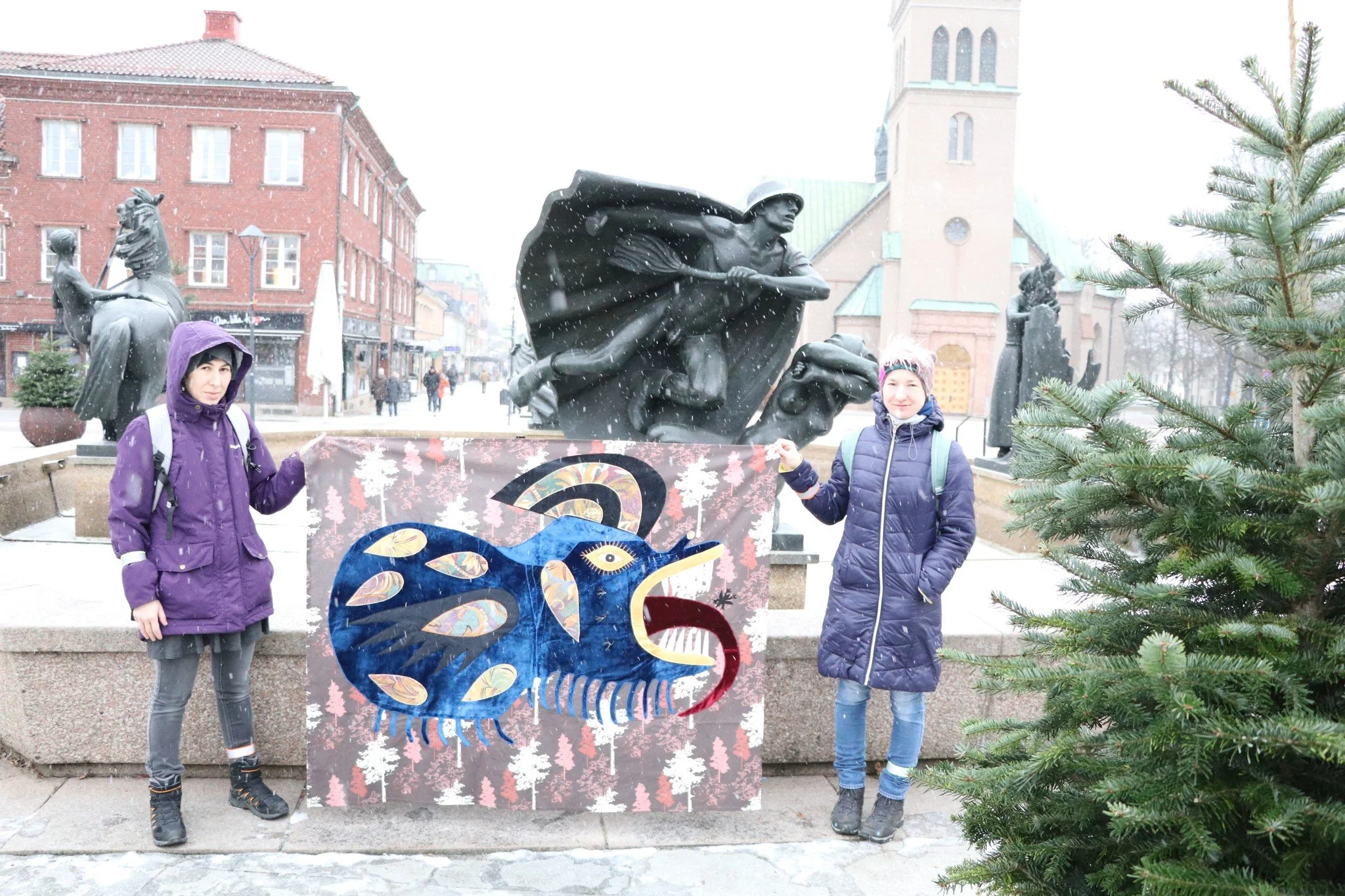
Photo 2 – Textile anti-war banner inspired by Maria Prymachenko’s work addressing Reagan (1986). Created by artists Ton Melnyk and Masha Ravlyk of the Ukrainian feminist collective ReSew (2022). Photo courtesy: Ton Melnyk and Masha Ravlyk(rights owned by the creators).
From this perspective, the Cold War appears not as an ideological rivalry but a shared imperial project. The United States and the Soviet Union deployed nuclear technologies through the same extractive logics: dispossessing Indigenous lands, racializing labor and bodies, and enforcing militarized notions of “progress.” What is remembered as competition was, in practice, entanglement in sustaining hierarchical world orders.
Across the irradiated landscapes of the Marshall Islands, Semipalatinsk, Chornobyl, and Tamil Nadu, the question was whose land, whose body, and whose future could be sacrificed for the empire’s technological dreams. Nuclear infrastructures became mechanisms of domination and erasure, rendering entire regions expendable in the name of modernity.
Yet, even within these zones of sacrifice, resistance endures. From Prymachenko’s painting and Ukrainian anti-nuclear art to Tamil women’s protests and Qazaq performances reclaiming contaminated lands, such acts of defiance refuse the logic of disposability. They are not isolated protests but threads of care and imagination that connect distant geographies. Such connections are established through the shared conditions of nuclear imperialism—ecological devastation, dispossession, and the collective labor of survival and refusal.
I approach these histories through a postsocialist queer lens—not as a matter of identity, but as a way of tracing how time, sovereignty, and normativity are reshaped after socialism. This framework reveals nuclear histories not as “U.S. versus Soviet” stories but as overlapping systems of empire. I expand on this argument with several examples from Eastern Europe, Central Asia, and South Asia, which might appear entirely unrelated but are actually entangled through the workings of nuclear imperialism.
Examples in action
The struggle against nuclear imperialism continues today. In Kudankulam, Dalit and fishing communities, especially women, have long resisted Russian-built reactors on their coast. Their protests, grounded in ecological care and local knowledge, challenge the same militarized development driving Russia’s nuclear expansion and environmental neglect in Ukraine and Belarus. Unsurprisingly, they invoked the Chornobyl moment in their claims against the construction.
Artists and activists across these regions share what I call translocal solidarities—connections built not through diplomacy, but through shared refusal of ecological harm and state violence. Prymachenko’s art, Arundhati Roy’s essays, and grassroots movements from Tamil Nadu to Belarus reveal how Cold War logics still shape today’s “nuclear future.” They show that survival, memory, and care are political acts. For instance, Tamil women in Idinthakarai invoke Chornobyl in their chants, treating collective memory as resistance to nuclear disposability. Belarusian activists similarly turn remembrance into protest through the Čarnobyĺski Šliach march, carrying the trauma of 1986 into the streets to challenge ongoing nuclear expansion and authoritarian repression. In Semipalatinsk, Qazaq artists and community organizers stage performances on irradiated lands to reclaim relationships with place and ancestors, insisting that care for damaged ecologies is a demand for justice rather than a private burden. And in Ukraine, the feminist collective ReSew reworks Prymachenko’s anti-nuclear animals into textile protest banners, confronting Russia’s invasion and nuclear blackmail through art that refuses imperial violence and affirms collective survival. These movements do not merely oppose nuclear power—they reimagine how we live with damaged lands and futures.
A queer postsocialist lens, thus, rejects the notion that empire is over. The Cold War remains an unfinished story of nuclear infrastructures, poisoned lands, and forgotten communities. Queerness, here, is an act of political imagination—the ability to link distant, damaged places and to dream otherwise.
As the article argues, nuclear imperialism produces racialized expendability not only through war, but through infrastructure—by deciding which lands can be irradiated, whose bodies can be sacrificed, and whose futures erased. Reading across geographies calls for a feminist, decolonial internationalism that centers the creativity and courage of those living amid radiation and repression.
Maria Prymachenko’s “cursed monster” is not just protesting bombs—it demands we rethink what power, refusal, and survival might mean beyond the empire. A postsocialist queer reading teaches us that the nuclear age is not behind us. Rather, it is embedded in how decisions are made now about land, safety, labor, and whose lives matter.
If we take this seriously, our struggles against nuclear harm must always be relational, grounded, and imaginative. They must draw lines not only through state architecture, but among distant communities, ecologies, and the stories of loss and resistance.
Read the full article here: “May That Nuclear War Be Cursed!” A postsocialist queer reading of nuclear imperialism
Each blog post gives the views of the individual author(s) based on their published IFJP article. All posts published on ifjpglobal.org remain the intellectual property and copyright of the author or authors.
Tatsiana Shchurko is Assistant Professor of Instruction in the Department of Women’s, Gender, and Sexuality Studies at the University of South Florida. A queer feminist researcher and activist from Belarus, Shchurko works at the intersection of transnational and intersectional feminist theory, postsocialism, decolonial critique, and memory studies. Her scholarship explores empire and resistance across the U.S., Eurasia, and the Global South, particularly through art, politics, and archives. In 2023, they received an American Council of Learned Societies Fellowship to support a book project tracing links between U.S. Black women’s activism and Eurasian knowledge production. She also develops digital project The Archive Revisited, https://thearchiverevisited.com. You can reach her at shchurkot@gmail.com.