

Taking the Red Pill: Conspiracy Theories, Gender, and the “Elusive Epistemologies” of the “Manosphere”
By: Elspeth Van Veeren (SHE/HER), Elisabeth Moerking (SHE/HER) and Harvey Dryer (HE/HIM)
Twenty-five years after its release, The Matrix film has been reinterpreted from a progressive allegory into a key metaphor within anti-feminist manosphere communities. “Red pill” discourse has widely reframed feminist power as conspiracy and legitimized misogynistic violence. Through this study, we point to the important gender work of conspiracy theories and their reliance on futuristic imaginaries.
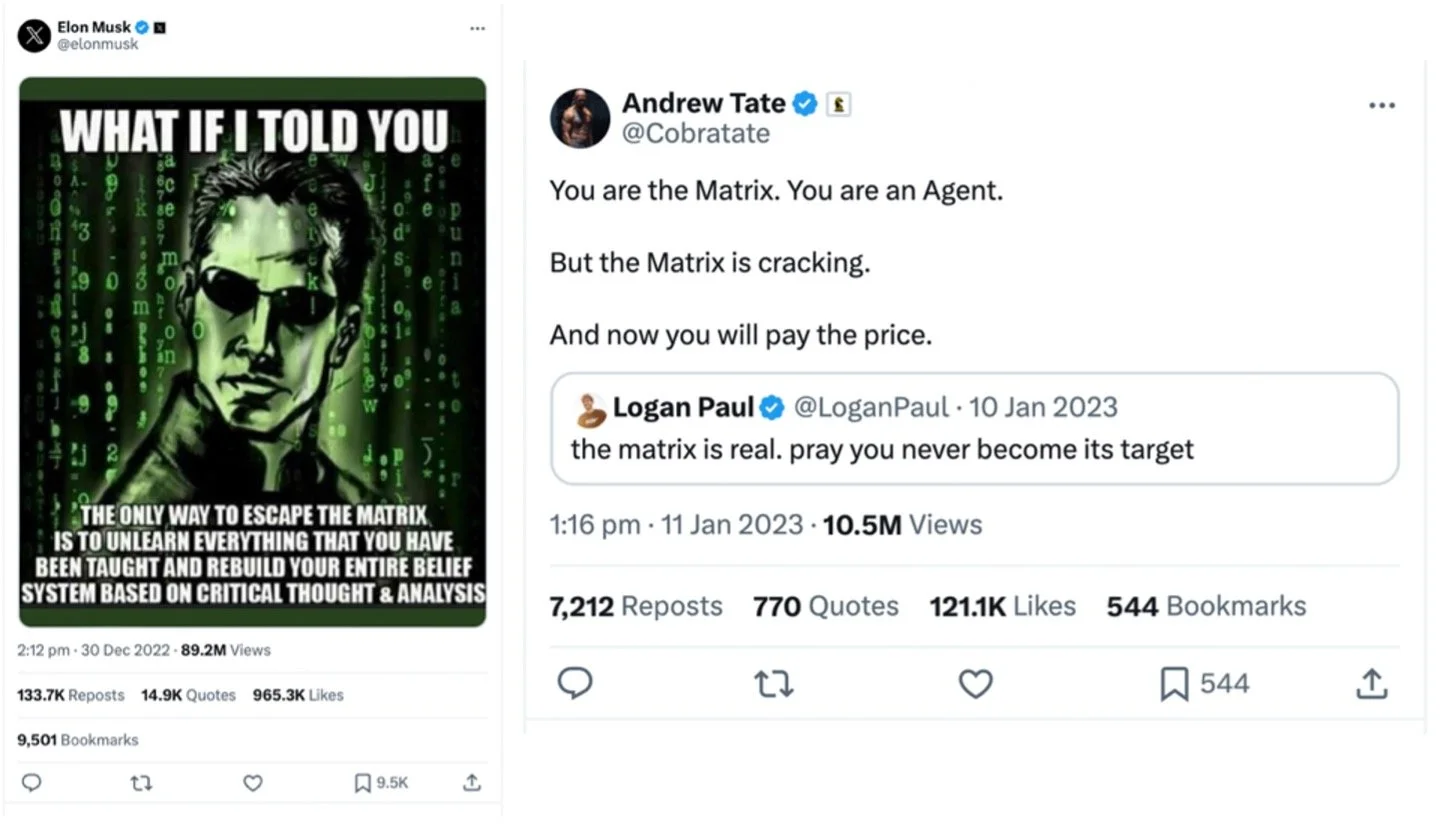
Musk, E. (2022) Screenshot of Matrix Meme, Dec 30th, 2022. Available at: https://x.com/elonmusk/status/1608828315581976576?lang=en-GB; Tate, A. (2023) Screenshot of Andrew Tate Matrix tweet intertext, Jan 11th 2023. Available at: https://x.com/Cobratate/status/1613162974746742786?lang=en
Twenty-five years on from its initial release, The Matrix (US: Wachowski and Wachowski, 1999) is widely regarded as one of the most iconic science fiction films ever made. In it, the protagonist Neo (played by Keanu Reeves), the prophetic “chosen one,” leads a revolution against the enslavement of humanity by machine overlords. Trapped in a dreamlike state and ‘plugged into’ the matrix—a complex simulation that deceives and pacifies humans into believing they are nevertheless free and living purposeful lives in the real world— humans serve as batteries, living and dying without understanding how completely unfree they are. In one of the movie’s most famous scenes, Neo, is given a choice between taking the “blue pill”, which will allow him to continue living this (half) life in ignorance in the matrix, or the “red pill”, which will physically awaken and unplug him and free him from tyranny. Neo, of course, takes the “red pill.”
Our inquiry into the ‘pill metaphor’ and its current and expanding cultural prevalence, therefore, started with the tension that exists between two divergent readings of The Matrix as text. The Matrix, in many interpretations, is a film that offers an anti-capitalist critique, depicting machines feeding on human energy, and a queer-affirming message, including, and especially, as a trans allegory. In more recent years, The Matrix has, however, emerged as a key frame of reference for the manosphere. Since the film’s release in 1999, the metaphor of “taking the red pill” has been increasingly co-opted by an expanding set of male supremacist and anti-feminist communities and influencers; men who align themselves with the idea of being ‘red-pillers’ or ‘red pilled’ consider themselves as awake to their enslavement and liberated from feminism’s oppressive system of control and look to support other men to awake and reclaim their status as ‘alpha’ men.
Our article, therefore, interrogates the gender politics of the anti-feminist “red pill” reading of The Matrix, and the conspiracy theories that are tied to it, to offer a critical reading of the manosphere’s co-optation of the films’ science fiction imageries. Jaron Haramban and Stef Aupers (2019) argue that conspiracy theories use multiple forms of evidence to support their claims to ‘truth’, including drawing on ‘ancient wisdom’, scientific language, and social theory. This evidence is also derived from the futuristic imaginaries of popular science fiction. Following their work, we argue that the intertextual references of The Matrix, as popular cultural text, help constitute a “common sense” of feminist oppression of men, aggrieved sexual entitlement and masculinized righteous rebellion. Based on a discourse analysis of prominent “red pill” YouTube channels, we find that these intertextual references allow influencers across the manosphere to repackage a whole set of anti-feminist conspiratorial worldviews under the banner of a single metaphor.
“Red pill conspiracy theories are not merely ‘dorky’ iterations of misogynistic ideas but are part of a wider ecosystem of violence that is composed of practices such as doxxing, rape threats, death threats, as well as instances of mass violence and terrorism.”
Feeding on the life energy of men
Firstly, we identify that an underlying feature across “red pill” discourse is the belief in the very existence of a conspiracy, referred to as “The Matrix”, that functions to enslave ordinary citizens. According to this widely spread conspiracy theory that includes proponents such as Elon Musk and Andrew Tate, the world, our choices, and our individual futures are in fact “evil” systems of control. Within the “red pill” discourses we studied, this Matrix manifests in the form of a feminist ideology that seeks to control men politically, economically, and sexually to their detriment.
In particular, this conspiracy theory rests on an assumed distinction between “good” and “bad” women, with “bad” women being represented as manipulative, deceptive, promiscuous and hyper-empowered. Much like the machine overlords in The Matrix movies, these “bad” women are portrayed as “feeding on the life energy of men”. Enslaved by this system of control, men are systematically denied access to “good” women and with it, their rightful place in a natural gender order. In several of the videos we analyzed, this denial was further framed as a threat against “Western civilization.” Within this framing, men, and in particular white men, have become the victims of a feminist conspiracy to destroy the survival of Western masculinity. As such, there is an explicitly racialized, gendered and sexualized component to this conspiracy theory.
Righteous rebellion
Further, we find that this notion of red pill liberation is key to the construction of a narrative around “righteous rebellion”. This very closely mirrors The Matrix’s portrayal of Neo as the “chosen one”, as the act of swallowing the red pill unites the manosphere’s masculine subjects in violent revolution. Those who have swallowed the red pill transcend to a state of awakening and realize a transformed masculine identity; they have freed themselves from the control imposed by feminism. To swallow the red pill, then, is a transformative act of liberation that seeks to legitimize misogynist violence as rebellion.
By critically examining the mobilization of The Matrix within anti-feminist conspiracy theories, we show that red pill conspiracy theories are not merely ‘dorky’ iterations of misogynistic ideas but are part of a wider ecosystem of violence that is composed of practices such as doxxing, rape threats, death threats, as well as instances of mass violence and terrorism. Recent attacks, including the 2023 Allen, Texas mall shooting, the murder of Bianca Devins in 2019, and the 2014 Isla Vista shooting, can all be linked to red pill ideologies. Acts of anti-feminist violence are even being documented through fictional television dramas, including Adolescence (2025), which explores the murder of a teenage girl by a 13-year-old ‘incel’ and has garnered large amounts of political attention. As such, our article does not merely contribute to various academic literatures but also contributes to a wider, popular conversation about the cultural scaffolding that sustains contemporary misogyny.
Read the full article here: Taking the red pill: Conspiracy theories, gender, and the “elusive epistemologies” of the “manosphere”
Each blog post gives the views of the individual author(s) based on their published IFJP article. All posts published on ifjpglobal.org remain the intellectual property and copyright of the author or authors.



Elspeth Van Veeren is an Associate Professor of Global Politics in the School of Sociology, Politics and International Studies at the University of Bristol, UK, and coordinator of the Secrecy, Power and Ignorance research Network (SPIN). Her work is focused on US security cultures and policies, particularly in relation to the US Global War on Terror and its legacies. More recently, her work has included a focus on secrecy and the interconnections between personal and everyday secret-keeping that takes gender, sexuality and race as central to secrecy on national and transnational scales.
Elisabeth Moerking (she/her) recently completed her PhD at the University of Bristol, UK. Her research explores the politics of reactionary humor, with a particular focus on the visual and digital cultures of far-right memes. Her work has been published in journals such as International Political Sociology and Critical Studies on Security.
Harvey Dryer is an independent scholar specializing in gender, sexuality, and social inequalities, with a particular focus on white, heterosexual masculinities. He completed a Master’s degree in Gender and Politics at the University of Bath, UK, where his work explored gendered dimensions of health impacts across South Asia, the politics of gender inequality, and lesbian, gay, bisexual, transgender, intersex, and queer (LGBTIQ+) politics in the Global South. His research is grounded in queer feminist theory and centers on how heterosexual norms shape lived experiences, particularly among communities facing heightened vulnerability, such as homeless populations.