
Gender, Agency, and Vulnerability: LGBT Martial Arts Groups (MAGs) in Timor-Leste
By: LILI CHEN (She/Her) AND LAURA SJOBERG
It is often assumed that Martial Arts Groups (MAGs) in Timor-Leste are like gangs, and hypermasculinity is the only gender concept useful for thinking about people’s involvement in these organisations. From LGBT MAGs members, we learn these assumptions don’t work: MAGs are distinct organisations with complex and multidirectional gender dynamics.
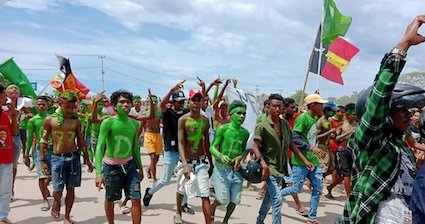
MAGs are mobilized in a political campaign. Photo credit: Lili Chen (2022).
Failing to integrate gender analysis when studying MAGs results in a partial and skewed account of the organizations, including the mischaracterization of members and misunderstanding of MAGs.
Martial Arts Groups in Timor-Leste
Many reports (and even policies) about Martial Arts Groups (MAGs) in Timor-Leste tend to treat them as if they are gangs, and therefore use the analytical lenses highlighting masculinity and violence. These lenses are often used to think about gangs to address their structures, their membership, their activities and their cultures. Seeing MAGs from a gender-blind perspective may miss the complexities within and among their organizational structures and functions, as well as the unique experiences of MAGs members.
In-depth research on these organizations suggests that this is a bad approach – that MAGs and their counterparts Ritual Arts Groups (RAGs) which have different emphases on martial arts training or ritual practices are more complicated, and that those complications mean traditional theories about gangs do not fit. MAGs in Timor-Leste play a significant role in politics and societies: some fought against Indonesian occupation and participated in political campaigns, while others maintain the communal order and provide humanitarian assistance They do work to structure the lives and identities of their members, and include significant non-violence pedagogy and spirituality in everyday practices, among other features that are uncommon among gangs.
While the gender theories can often explain the violent practices in many such organizations, reducing MAGs to the social exercise of hypermasculinity provides an inadequate description of them, both in theory and in practice. This project, by having conversations with LGBT members of MAGs about sex, gender, and sexuality, looks at the more complex gender dynamics that can be found in these organizations, and what that can tell us about what they are and how they work.
Gender in Martial Arts Groups
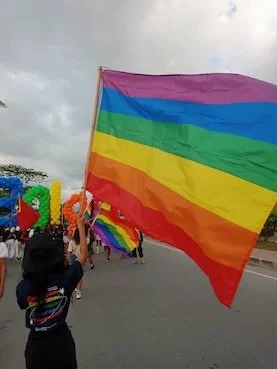
Pride March in Timor-Leste. Photo credit: Lili Chen (2023).
A broad gender-analytic view of MAGs in Timor-Leste is not just about women, but about gender identity, sexual orientation, and the intersection of these with race, class, ethnicity, age, and other lived experiences. MAGs members include transgenders, gays and lesbians aside from men and women. In this project, we asked questions about gender to LGBT members of MAGs, and analyzed their responses through gender lenses. We learned several things we find to be important, both in theorizing and in practical terms.
For this study, we interviewed 10 Timorese MAG-member informants who identified as trans and/or lesbian. Some of our LGBT participants talked about joining MAGs for protection against homophobic violence. Others told us about cross-MAG networks for LGBT members of any MAG which they used for support both about how to live in Timor-Leste as an LGBT person and how to navigate the MAGs they had joined. We found that the idea of ‘brotherhood’ which is at the center of many MAGs and is usually characterized as exclusive to men, is actually a wider concept. Women, too, can be ‘brothers’ and there are LGBT brotherhoods in the organizations. As ‘brothers’, all MAGs members have to look after each other and respect each other in times of need.
We learnt from some of our participants that they had consciously performed hypermasculinity to ‘fit in’, while others felt quite comfortable ‘being themselves’—expressing their gender identity, including but not limited to showing that they were trans. Several of the MAG members highlighted the significance of feminized values like empathy, in shaping their experience as MAG members.
Lessons from LGBT Martial Arts Group members
The story that our interviewees told of MAGs and gender is a complicated one – where the organizations are both violent and nonviolent; both cisheterosexist and gender diverse; both uniform and provide space for difference; and both hypermasculine and empathetic. By using gender analysis to understand the lived experiences of LGBT MAGs members, our article highlighted these gendered dimensions of MAGs principles, operation, and membership. How they are gendered and gendering are situated in hybrid, fluid, and overlapping social and communal relations and identities. Our article theorizes these MAGs’ complicated gender roles, impacts, and implications in post-conflict Timor-Leste with a more holistic approach incorporating an ethnographic understanding of the complex social and power relations and dynamics. It also encourages future scholars to look at these complexities by refusing to accept any simple framing and one-sided story of it.
Read the full article here: Gender, agency, and vulnerability of LGBT martial arts group members of Timor-Leste
Each blog post gives the views of the individual author(s) based on their published IFJP article. All posts published on ifjpglobal.org remain the intellectual property and copyright of the author or authors.
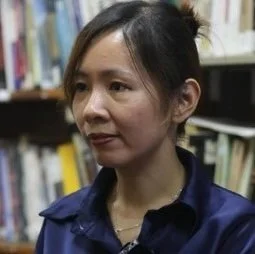
Lili Chen is a visiting lecturer at the Department of Political Science, Faculty of Social Sciences, Universidade Nacional Timor Lorosa’e of Timor-Leste. She has been a consultant for Oxfam, Care International, and UN agencies in Timor-Leste. Her research interests include human rights, women, peace and security, as well as politics in Southeast Asia with a particular focus on Timor-Leste. Her current ongoing research projects focus on indigenous sexuality in Timor-Leste and women at borders.
Laura Sjoberg is Professor of International Relations in the Department of Politics and International Relations at the University of Oxford, and Kloppenburg Official Fellow of Politics and International Relations at Exeter College.