
Beyond State Immunity: How Feminist Interventions Enabled Survivor-Centred Justice in the Comfort Women v. Japan Rulings
By: chloe M. Kwak (she/her)
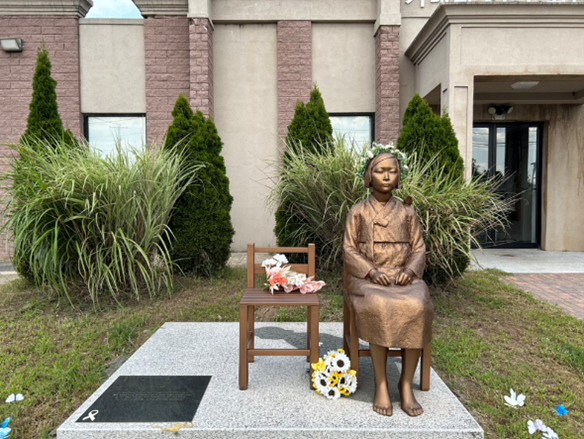
A Statue of Peace commemorating victim-survivors of the “comfort women” system in Connecticut, United States. Picture credit: Chloe M. Kwak
For decades, survivors of the "comfort women" system, a network of military sexual slavery established by Imperial Japan between 1932 and 1945, were told that the law could not hear them. This system involved the systematic enslavement of women from across occupied Asia and beyond, including Korea and China, the Philippines, Taiwan, Indonesia, Malaysia, Burma, Vietnam, and the Netherlands. These victims were recruited through coercion, deception, or force. While the Japanese government has offered apologies and compensation, these efforts consistently failed as Japan refused to acknowledge legal responsibility, opting for private-sector funds over official state reparations. In addition, courts dismissed claims, treaties foreclosed redress, and state immunity operated as a legal wall between survivors and accountability. Yet two South Korean rulings in 2021 and 2023, commonly referred to as Comfort Women v. Japan, cracked that wall by denying Japan’s claim to state immunity and affirming survivors’ right to justice. My article asks how domestic courts came to reason this way after decades in which international law often rendered wartime sexual violence legally peripheral.
I argue that these rulings became possible through feminist interventions in international law that challenged its patriarchal foundations and advanced women’s rights and survivor-centred approaches. The courts did not label their reasoning as ‘feminist’. Yet their legal architecture reflects long-standing feminist efforts to recognize sexual violence as a grave human rights violation, to treat women’s rights as human rights, and to reject the idea that state immunity should shield states from accountability for atrocity.
The 2021 ruling was groundbreaking in framing wartime sexual slavery as a violation of peremptory norms, jus cogens. Codified under the Vienna Convention on the Law of Treaties 1969, jus cogens indicates inviolability and superiority over any other law or treaty. As a result, the court reasoned that state immunity cannot shield a foreign state from jurisdiction when it violates these fundamental norms. This move is significant because international law tends to prioritize “masculine” public violence while sidelining gendered harms. By treating sexual slavery as a non-derogable violation, the court forced the legal system to recognize women’s lived experiences as central to global human rights.
The 2023 ruling reached a similarly survivor-friendly outcome through a different doctrinal path. Rather than relying on jus cogens, it emphasized the territorial tort exception to state immunity. This implies that a foreign state cannot claim immunity for illegal acts committed within the forum state’s borders. By focusing on the victims' status as citizens, the court treated survivors as rights-bearing legal persons whose access to justice is grounded in their membership in a political community. This approach simplifies the legal struggle by avoiding the contested debate over whether sexual violence constitutes an independent jus cogens norm. Instead, it argues that no state should be allowed to harm people on another’s soil without facing accountability. Ultimately, this challenges the state-centric and male-centered tendencies of international law by prioritizing the tangible, domestic rights of citizens over the abstract, sovereign privileges of a foreign government.
The decisions under these rulings devote substantial attention to the historical record and to survivors’ life histories, treating their testimonies as legal evidence that defines the nature of the wrong and the meaning of redress. This marks a shift away from approaches that privilege state interests or abstract procedural doctrines over lived harm.
However, enforcement remains uncertain, especially given Japan’s rejection of the judgments. Yet measuring these rulings solely by financial compensation loses their broader significance. They establish an official record that prioritizes state responsibility over immunity, affirms survivors’ dignity as rights-bearing subjects, and generates precedents that can travel across legal contexts. These 2021 and 2023 decisions demonstrate how feminist engagements can reshape legal boundaries by centering women’s lived experiences as foundational to international norms. By transforming sexual violence from a peripheral "private" harm into a central concern of global justice, these rulings establish a framework for survivor-centred reasoning within judicial systems. Moving forward, this research suggests that the next frontier lies in institutionalizing these domestic shifts into a transnational framework to ensure that gendered atrocities are no longer sidelined by the state-centric architecture of international law.
Read the full article here: Beyond state immunity: feminist interventions in international law and survivor-centered justice in the Comfort Women v. Japan rulings
Each blog post gives the views of the individual author(s) based on their published IFJP article. All posts published on ifjpglobal.org remain the intellectual property and copyright of the author or authors.
Chloe M. Kwak is a PhD candidate in Political Science at the University of Connecticut. Her research examines feminist engagements with international law and diasporic memory activism surrounding the ‘comfort women’ issue.